Super Over 47
10 December 2025

Ball 1
Wow!
In no time, England has gone from optimism to the brink of total disaster.
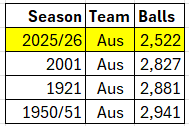
Australia have skipped to a 2-0 lead after just 2,522 balls. No side has ever won the first two Tests of an Ashes series so quickly. The old record, set by Australia in 2001 has been blitzed by 305 balls. That’s about 51 overs!
I said ‘brink of disaster’ above. Most would argue it already is a total disaster. There are indications of ructions within the team, Mark Wood is now out for the tour, ex-players are apoplectic: it has all the hallmarks of some of England’s recent disasters - 2021/22, 2017/18, 2013/14, 2006/07, 2002/03, 1998/99, 1994/95 and 1990/91 … in other words, every single tour except 2010/11.
Bazball is hanging by a thread. If England lose in Adelaide there will be hell to pay. 5-0 is a real possibility.
It is almost, but not quite, impossible to see them winning the series. As I love to say, only once has a side come back from 2-0 to win 3-2: Bradman’s Aussies of 1936/37 in which Bradman scored 270, 212 and 169 in the last three Tests.
As good as Root might be, he’s no Bradman.
Nevertheless, England could still win in Adelaide. I’m not predicting it, as such, but stranger things have happened!
Ball 2
For all his flair, one of Shane Warne’s most insightful principles was one of patience.
Too often, he said, bowlers got discouraged after an over or two and tried something new.
Far better to keep bowling your best ball - for hours if necessary: eventually natural variation would kick in and the batter would be undone.
I wonder what Warnie would have made of Brydon Carse’s performance at the Gabba.
Here is his first over of the match. One full ball (in blue) yielded no result - so BANG IT IN SHORT AND WIDE (yellow)!
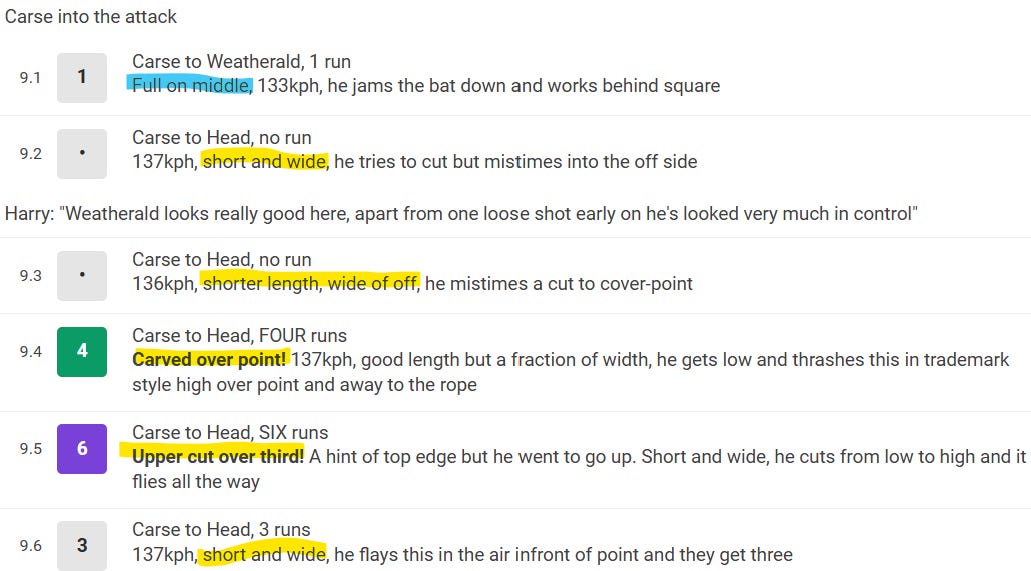
On and on it went. At one point Carse had bowled 12 overs and taken 1/95. Virtually 8 an over! Had England lost a bet and this was the penalty? It was like watching a game of basketball in which one player immediately hurled the ball at the backboard as soon as they caught it, regardless of where they were on the court.
Carse did pick up some wickets - including bowling Green who had backed away to leg and having Smith caught off a full blooded hook shot - to finish with 29 overs 4/152. But these were far too little and too late to justify his approach.
On a pitch that offered something for bowlers throughout all that was required was line and length, a ring field and patience. That’s what Michael Neser proved. Guess who else might have? 43-year-old Jimmy Anderson!
Ball 3
Regular readers will know I have been less of a Mitchell Starc fan than others.
Not anymore! I am converted; I have seen the light! Right now, he’s the first quick I would pick.
Starc’s series stats after the first two Tests are astonishing:
18 wickets at an average of 14.0 with a strike rate of 20.9. That’s a wicket every three-and-a-half overs!
89 runs at an average of 44.5
Even if he can’t quite keep going at this exalted level, he’s on track for one of the greatest series ever. He is in the form of his life, at 35.
Cricinfo has a neat feature called ‘reverse cumulative’ which allows you to play someone’s career in reverse. If time ran backwards, and the Gabba Test was Starc’s first, here is how his first 15 Tests would look:
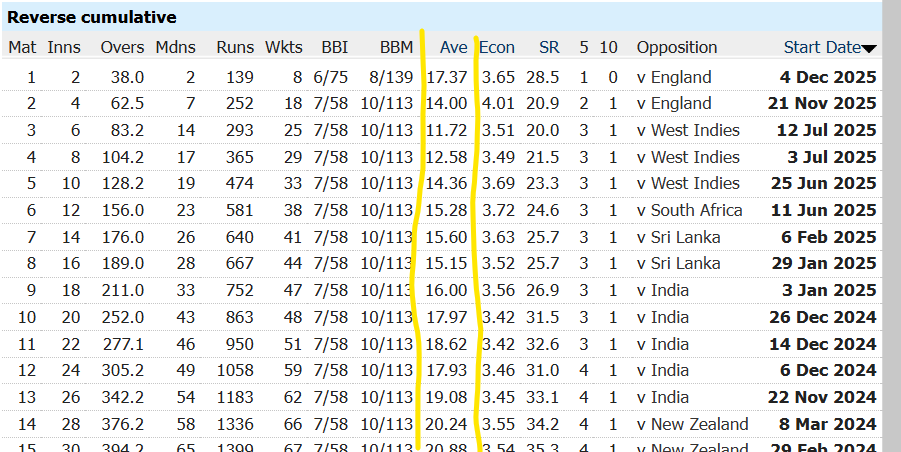
An average in the teens for much of it; a strike rate in the 30s. And I heard Gerard Whateley make the point on SEN: he has stopped bowling the bad ball! He used to spray it round a bit and then bowl an unplayable one. Now he’s still bowling the unplayable ones but in and around them he is approaching McGrath-like metronomic accuracy.
It is quite something to behold and long may it continue.
Ball 4
Have a look at the Australian free-to-air television ratings for the first day of the Gabba Test.
The three columns of numbers are total reach, average and digital viewers:
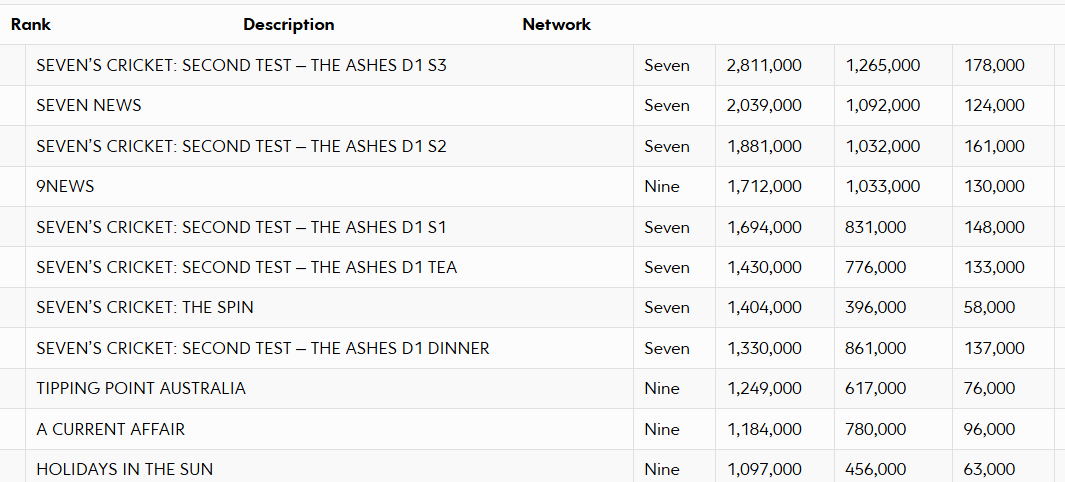
Six of Australia’s top seven shows were the cricket!
And if Foxtel/Kayo’s numbers - which they no longer seem to readily make available - were added in, maybe the average would jump by about half a million.
But the most interesting feature to me is how much the third session - in primetime - out-rates the other two. 2.8 million viewers watched at least some of the third session: roughly a million more than either the first or second.
That final session lasts from 8pm until 10:30pm in Sydney and Melbourne. Ever since the beginning of TV it has been the time people tune in most.
This is the value of the pink ball Test.
Sure, I get it: the format is not perfect. But if this Test had finished each day at 6:30pm it simply would not have dominated the conversation the way it has done in Australia.
Ball 5
Before the match I posted a video explaining why I would drop Lyon, highlighting that although he does have a good pink-ball record, the Aussie quicks have better records than Lyon - and that spinners generally don’t figure in pink-ball games.
Predictably though, most ex-players strongly disagreed with his omission. This quote sums it up:
‘I never feel comfortable without a spinner. Lyon has a good record in Brisbane and with the pink ball and the bounce in the pitch would have suited him. And even when not taking wickets, he gives the captain control and allows the quicks to be rotated from the other end.’
No-one actually said that - I just made it up. But I trust you agree it’s a pretty decent amalgam of what the ex players said, indeed, what they always say.
And no doubt they felt vindicated during much of Day 1 as Australia’s quicks (with the exception of Starc) struggled to penetrate. I admit I was starting to feel the same way.
But now the match is over, surely the selectors have been proven right in picking Neser. He took 6/85 in the match and all-told, spinners across both sides bowled just 13.3 overs - taking one wicket. It was a brave decision by George Bailey and co - and they deserve congratulations.
Ball 6
I loathe conspiracy theories. But I am coming round to the idea that cricket does not want to fix the over rate issue.
Imagine you ran cricket: the financial health of the game was your responsibility. Which would you prefer?
The Gabba Test (that lasted 279.1 overs) having proper over rates and ending an hour into the fourth day
It finishing late on day 4 - in prime time - due to slow over rates.
It’s a no brainer.
The third session on day 4 - as Australia surged victory - had a reach of nearly 3.2 million people on Channel 7 alone. Had they been forced to switch to regular programming and shown a repeat of Better Homes and Gardens or something, the figure would have been vastly lower.
Cricket Australia are getting $1.5 billion over seven years from Channel 7 and Foxtel. They are also getting $360 million over seven years with their India television deal. With this sort of cash on the table it is vital to keep the broadcasters happy - and don’t forget, it wasn’t that long ago that Channel 7 took legal action against Cricket Australia, saying they weren’t getting fair value from their deal.
Maybe this explains why the over rate issue has basically been ignored.
Australia took it to ludicrous extremes on the first day of the Gabba Test: by the scheduled stumps time only 68 overs had been bowled, 22 fewer than the required 90. And because England’s innings ultimately lasted less than 80 overs Australia won’t even get punished!
Madness … but the result was everyone’s talking about Smith and Archer! And Channel 7 are very happy.