Super Over 46
29 November 2025

Ball 1
I cannot agree with Gus Gould.
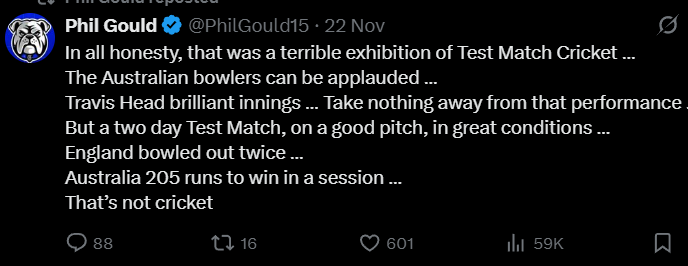
I thought it was two days of spectacularly watchable cricket; people forget how turgid Test cricket often used to be.
I can recall matches in the 1980s and 1990s that seemed destined for draws from the first session.
I remember the first day of the SCG Test of 1997/98: South Africa finished on 5/197 from 97 overs - a run rate of 2.03.
Whenever I make this sort of point people reply, ‘If you don’t like the grind between bat and ball stick to T20 champ.’ The thing is, I can appreciate a gritty, tough innings as much as the next person, but so often in the bad old days this was not the case. Too often, batters were overly defensive by default - it didn’t matter whether the bowling was good or bad, if they got a short ball outside off stump they let it go.
Give me modern players any day.
And, what about the crowd! 101,514: the second highest attendance for a Perth Test match ever - and it lasted just two days.
The first Ashes series I can remember in Australia was 1986/87. What do you think the attendances were on the first two days of the first Test?
The answer: 14 and 15 November 1986 at the Gabba saw crowds of 9,892 and 7,980.
Nostalgia can sometimes mask the truth. Test cricket is better now than it has ever been in my lifetime - by a chasm.
Maybe the only tweak needed is to give each Team a third innings . . .
Ball 2
’I just can’t see how they can bounce back’, said Mark Waugh, before going on to predict an Australian series whitewash.
When was this - yesterday?
No - it was after Australia rolled India for 36 in the first Test of 2020/21. Many are saying the same now about England.
It would not be a surprise if Australia won 5-0 or similar.
But, just as India rallied to win that 2020/21 series, I have not ruled England out. (Caveat, I have said this before about England in Australia - only to be proven wrong!)
At lunch on day 2 in Perth, with a lead of about 100 and 9 wickets in hand, England were well on top. At that instant, no-one was predicting Australia winning 5-0.
The subsequent madcap four hours in which England were humiliated should not totally obscure their dominance of the first eight hours.
In 2005, after an eternity of Aussie dominance, England went into the Ashes seriously giving themselves a chance. They started well in the first Test at Lord’s - only for the Aussies to steamroll them in the second innings.
It is not at all inconceivable that England might hit back now, just as they did then.
Ball 3
I have been dismayed by the reaction to Usman Khawaja’s first Test travails.
Yes, it was a bit unfortunate that his bad back forced a change in the batting order.
But I reject the notion that this hampered Labuschagne and Smith. I mean, do people think that they weren’t expecting to bat? Batting out of position didn’t seem to hamper Head much in the second innings.
Then there was the anger that Khawaja had been playing golf the day before, even though the spasms were apparently unrelated. Some of what I have seen on social media has been downright unpleasant.
Khawaja entered the Test with his position fairly solid; he leaves it on the verge of his international career being ended. Even if you think this is what should happen, surely it is not something to be celebrated.
Ball 4
So, who would my eleven be for the day/night Test in Brisbane?
I’m glad you asked.
Rather than going rogue with some left-field choices, I’ll pick an eleven from the squad selected - which is unchanged from the first Test.

I would replace Lyon with Webster. Yes, this means losing a bowler for an all-rounder, but I think sides often miss a trick by not lengthening their batting orders in pink-ball Tests. If, as expected, the ball dominates bat, the extra batter could be decisive.
If it unexpectedly is a high-scoring Test, Australia would still be fine: three big quicks, plus Green, plus Webster. And if it turns, Webster’s offspin will be fine - his spin looked excellent in his few overs in Sri Lanka.
Doggett looked okay in Perth but I favour Neser with the pink ball - and he would strengthen the batting too.
That leaves three batters fighting for two spots. I rate Inglis and want him in there, so it is Weatherald versus Khawaja.
Although I am not convinced about Weatherald and do not want to drop Khawaja, it comes down to one question: who is Australia more likely to win with? And, I think that a quickfire 40 from Weatherald is more likely than a painstaking 40 from 100 from Khawaja against the pink ball.
So here is my side:
1. Weatherald
2. Head
3. Labuschagne
4. Smith
5. Green
6. Inglis
7. Webster
8. Carey
9. Neser
10. Starc
11. Boland
What do you reckon? Even if you disagree, do admit that having a batter of Starc’s quality at 10 is pretty powerful!
PS, I kind of hope they stick with Khawaja though - and I’ll be cheering him on if they do.
Ball 5
The controversy around the dismissal of Jamie Smith in the second innings was predictable.
With a gap between bat and ball at the time of the spike, no wonder partisan English fans were furious.
When I posted in defence of the decision, those who disagreed with me tended to cite one (or more) of four reasons:
I must be biased because I am an Aussie
How can it be out if the spike did not align with the ball passing the edge of the bat
The fact the umpire took so long shows there was doubt - and so the batter should have got the benefit of it
The same arguments used to justify it being out could have applied to the Labuschagne one the day before (when he was given not out) and clearly I must just be a biased Aussie!
Here are my responses:
1. It’s fascinating how some people assume that their own bias is universal. Sure, I want Australia to win - but it is just a sport: it’s not that hard to be objective.
Here is me - a younger looking me - talking about the same issue during the 2019 Ashes. I probably didn’t quite get the explanation perfect but the thrust of it is correct - and, those who accuse me of bias please note, I was arguing in favour of David Warner having been given out!
2. The possibility of the audio not lining up with the vision is not new and has been well explained. Former top umpire, Simon Taufel, said this, on Channel Seven:
The conclusive evidence protocols with RTS - if you get a spike up to one frame past the bat, that is conclusive. And in this particular case, that is exactly what was there.
3. It is a pity the third umpire took so long. As Taufel said above, the protocol demanded it be given out. Taufel continued with:
Unfortunately, he didn’t want to pull the trigger quite as quickly as perhaps he could have or should have. And the guys in the truck were doing their utmost to show him and to slow it down and to try rocking and rolling that frame.
For me, the correct decision was made. A spike RTS after one frame past the bat, the batter has got to go.
4. The Labuschagne one did not have a spike, it had a murmur. Yes, I am aware that the ‘spike’ in the Smith one was also not huge but there was a clear difference between the two. The umpires are trained to recognise the audio profile of a spike versus the murmur of, say, spikes scraping the turf (which is probably what the Labuschagne murmur represented).
Ball 6
Does this sound familiar?
England collapse, Australia collapse, England collapse again. Australia cruise to victory and the match is all over in record time.
No, I am not talking about the Perth Test just gone. I am referring to arguably the most important match in the history of cricket.
It took place 146 years ago - and helped make international cricket a thing. The 1878 Australians had been beaten soundly in their first match - against Nottinghamshire. Little was expected of them in their next match, at Lord’s.
To the astonishment of London, the Aussies not only beat the Marylebone Cricket Club (basically England) they did it inside one day. On a wet pitch, the MCC made 33; Australia 41 and then the MCC made just 19 in their second innings. Australia got the 12 required for the loss of 1 wicket - and England realised they had a competitor!
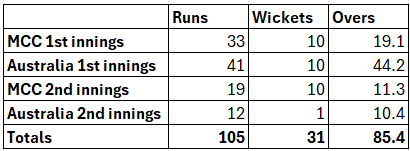
Despite the run rate being only 1.2, the match was watched with great excitement, and the crowd built all afternoon. It was all over in the equivalent of 85.4 six-ball overs. By comparison, the 141.1 overs in the recent Perth Test were quite a marathon.
Fred ‘the Demon’ Spofforth took 10 wickets (to earn himself a statue at the SCG) including WG Grace for a duck in the second innings.
The London satirical magazine, Punch, parodied the opening couplet of Lord Byron’s poem, The Destruction of Sennacherib. The original was:
The Assyrian came down like the wolf on the fold,
And his cohorts were gleaming in purple and gold;
Punch adapted it and added two extra lines, in reference to Grace’s duck:
The Australians came down like a wolf on the fold,
The Marylebone cracks for a trifle were bowled;
Our Grace before dinner was very soon done,
And Grace after dinner did not get a run.
There you go - from Travis Head cracking boundaries to a parody of a poem from 1815: that’s some culture for you!
I would love Neser to get another test. No one deserves it more.