Super Over 41
19 October 2025

Ball 1
The international men’s summer of cricket kicks off properly today with the first of a three-match ODI series against India, in Perth.
Cricinfo predicts the Aussie side to be:
1 Travis Head
2 Mitchell Marsh (capt)
3 Matt Short
4 Matt Renshaw
5 Josh Philippe (wk)
6 Mitch Owen
7 Cooper Connolly
8 Mitchell Starc
9 Nathan Ellis
10 Matt Kuhnemann
11 Josh Hazlewood
A good friend of mine will not be happy: he believes Connolly and Short are pedestrian domestic players - in fact it is making me chuckle at how he will react if they do both make the eleven.
It is a bit of a different looking side. No Maxwell, Cummins, Zampa and Inglis - and the rather unexpected return of Renshaw. Josh Philippe is also a surprise - and appears because second choice keeper Alex Carey is also unavailable.
For me, the continued absence of Tim David from the ODI side is utterly baffling. He is literally the first player I would pick. Whenever I say this, some people say that he does not want to play in ODIs - he wants to be free to play in domestic T20 leagues. If this is in fact the case, the selectors should make a statement to the effect that no matter what, David is in their plans for the 2027 world cup.
On the other hand, if they genuinely think David is not good enough to be in the side they should be arrested for stupidity.
India always look powerful, but I think I have seen stronger Indian sides. Their predicted side is:
1 Rohit Sharma
2 Shubman Gill (capt)
3 Virat Kohli
4 Shreyas Iyer
5 KL Rahul (wk)
6 Axar Patel
7 Nitish Reddy
8 Washington Sundar/Kuldeep Yadav
9 Harshit Rana
10 Mohammed Siraj
11 Prasidh Krishna/Arshdeep Singh
As always, there is a special lustre with matches played on Perth - the extra bounce is a big challenge for overseas players, especially first up!
Ball 2
Do you agree with Stuart Broad?
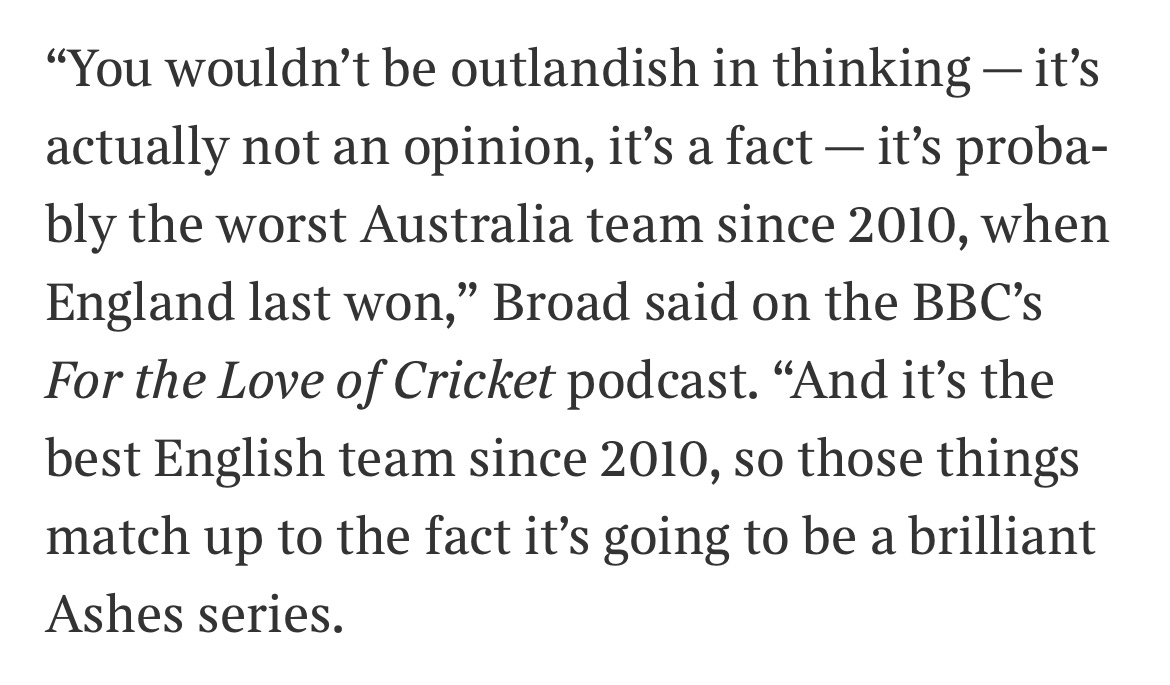
I think it probably is the best England side since 2010 but I don’t agree it is Australia’s worst.
To give you a quick guide, here is the first-Test 11 for Australia for the last three Ashes series in Australia and a possible first Test team for this season.
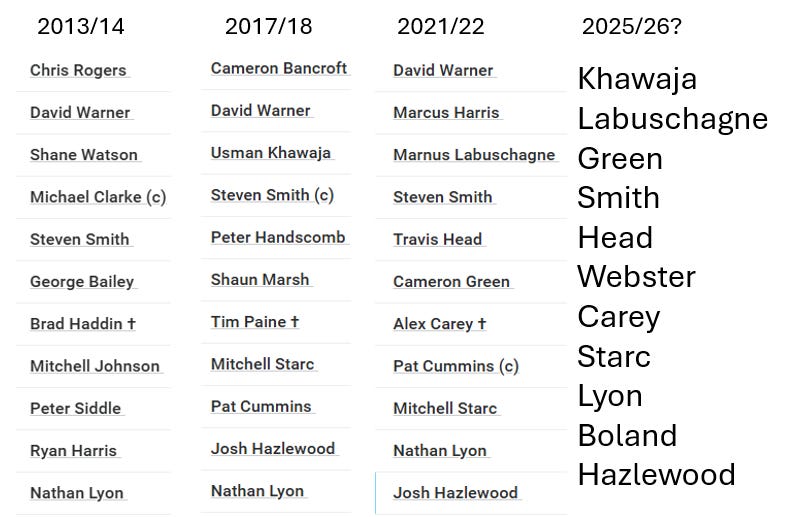
I actually don’t think there is a huge difference in standard amongst any of them.
In each, there have been a few top batters and a few somewhat iffy ones. Generally the quicks have been excellent and Lyon is consistent as the spinner.
A lot is being made of Australia’s uncertain top three and I think that whichever way the selectors opt it might well be a bit brittle. But I also think that the relatively difficult recent Tests need to be taken into account. Australia has gone from a tough home series against a Bumrah-led Indian attack, to a couple of easier Tests in Sri Lanka, to challenging pitches in the World Test Championship final and then the West Indies.
All in all, if I had to pick one side of the above four, I might even choose the current one - albeit, I am not especially happy with Lyon batting at 9: it’s a bit of a long tail.
Ball 3
I can’t help harping on about it: the ticket sales for the men’s international summer are extraordinary.
Here is a table with each day of the summer (Day 5 Test tickets are not sold in advance) with the days already sold out marked in blue.
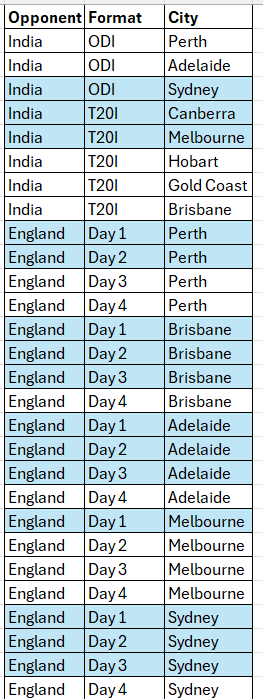
ODIs are really struggling in Australia - the fact Sydney sold out in June(!) shows how popular India is and especially how popular Virat Kohli and Rohit Sharma are. The pair has retired from other international formats and fans realise that chances to see them live are dwindling fast.
And the fact that Boxing Day is sold out (and Day 2 is all but sold out) is also pretty remarkable. Given fine weather and a good series, 26 December might well see the highest ever crowd for a day of cricket anywhere.
It is also a joy to see the MCG T20 has sold out. 15 or so years ago when T20s were new, there were a few games at the MCG with huge crowds and pulsating atmospheres. I well remember the sense of excitement and occasion as the players came out. It is great to see a return to this!
Ball 4
Regular readers will know that I have developed a soft spot for two Aussie quicks: Fergus O’Neill and Joel Paris. With O’Neill averaging just over 20 and Paris, incredibly, just under 20, I think the Aussie selectors should have their eye on both.
I was disappointed when O’Neill went wicketless in the first game of the Shield. I had made a social media post, disagreeing with the notion that potentially his lack of pace might mean he was not Test standard - only for him to put in maybe the worst bowling performance of his career!
No point in hiding from it though - I needed to take my medicine and mention it. So, yep - O’Neill took 0/58 and 0/43 in Victoria’s match against South Australia Sure, he did make 64 and 33* and helped guide the Vics to a tough win but it’s his bowling that really matters. And just one poor performance had already seen his average take a hit - it had risen to 21.12 after the game.
Happily, just as I was set to leave it at that, O’Neill hit back with a bang, taking 5/26 off 16 overs against NSW in round 2, (followed by 1/54 in the second innings). His average is back to 20.79 and surely, with Aussie quicks getting injured all over the place, he must be at least some chances of an Ashes call up.
It’s a less happy affair with Paris. As has always seemed the pattern for his whole career, his form is superb - and then he gets injured. This time it is a hamstring and he is not expected back until the Big Bash begins. Across the two List A and one Shield game he played this summer before the injury, Paris had taken 9 wickets at 12.33 and scored 49 runs at 24.5. He’ll soon turn 33, but I have not yet given up hope that maybe one day he will play for Australia.
Ball 5
A trivia question - a tough one.
To state the ridiculously obvious, the result of the first Test will be important in who wins the Ashes.
England are up against it: no real warm up games and then straight into a match on the bounciest pitch in the world. It will be their first ever Test at Perth Stadium - where it seems not only has the drop-in pitch kept the venom of the old WACA, the bounce also starts to get variable by Day 3 and beyond.
This leads me to the trivia question: can you nominate the last time that England lost the first Test of an Ashes series in Australia yet still went on to leave with the urn?
Answer below Ball 6.
Ball 6
I randomly came across this Sydney Morning Herald article from December 1974, when Don Bradman had been asked to pick his best Aussie post-World War II side, and readers competed to see who could get closest to it.
When I was kid, although Bradman would be seen watching the Adelaide Test each year, most of the rest of the time he was reclusive. So it was kind of a surprise to see him involved in something like this - a pleasant surprise.
Who would you pick, remembering that you’re limited to performances in the 1945-1974 period?
Here is Bradman’s side, and his accompanying article. The article is too small to easily read, so for those interested I have included a transcription at the bottom. (Note that he picked himself because the Herald told him he was to be the captain.)
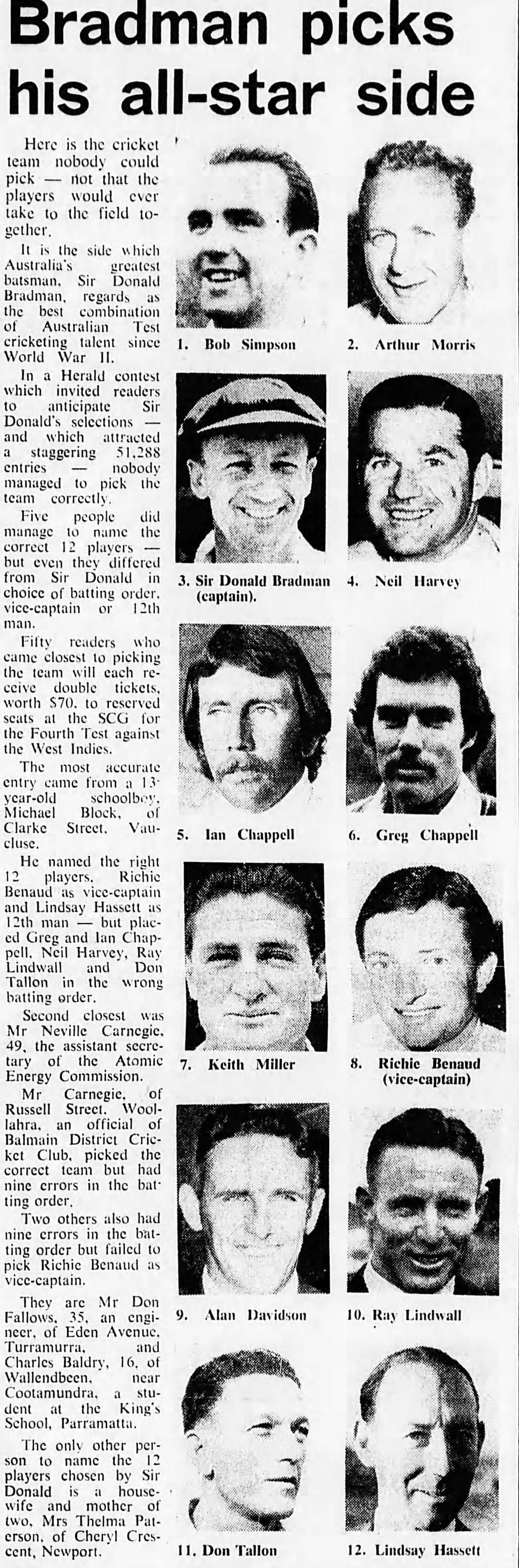
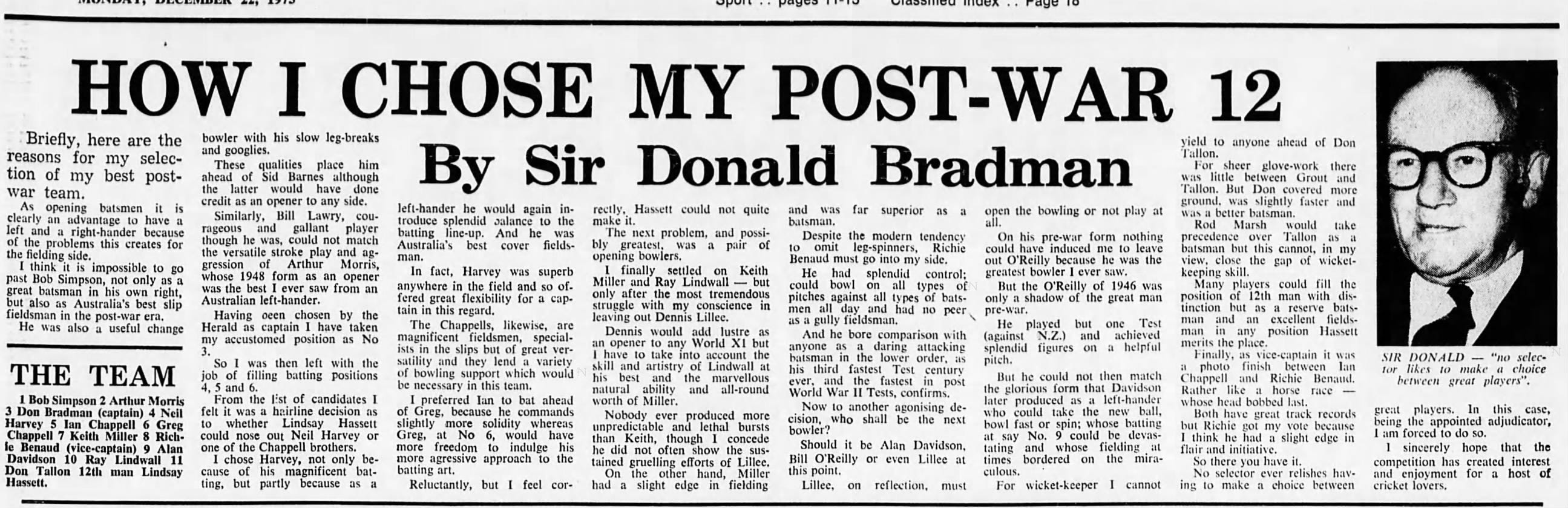
It’s a pretty decent side, I think and reasonably uncontroversial.
Personally, I’d have picked Rod Marsh over Don Tallon. Tallon wasn’t much with the bat and - as regular readers would know(!) - I think the value of ‘glovemanship’ is overplayed.
The big omission is clearly Dennis Lillee. I’d certainly have liked Lillee in there but I can see where Bradman is coming from - I’d find it hard to dislodge any of Miller, Davidson and Lindwall.
Anyway, enough of me - I’ll hand over to Don, lol. That reminds me of some writer (I can’t remember his name - let’s call him Bob Smith) who adapted a Shakespeare play and then had the nerve to declare the result, ‘written by Bob Smith and William Shakespeare.’
I hope you enjoyed this edition of the newsletter - written by Paul Dennett and Don Bradman.
HOW I CHOSE MY POST-WAR 12
By Sir Donald Bradman
Briefly, here are the reasons for my selection of my best post-war team.
As opening batsmen it is clearly an advantage to have a left and a right-hander because of the problems this creates for the fielding side.
I think it is impossible to go past Bob Simpson, not only as a great batsman in his own right, but also as Australia’s best slip fieldsman in the post-war era. He was also a useful change bowler with his slow leg-breaks and googlies.
These qualities place him ahead of Sid Barnes although the latter would have done credit as an opener to any side.
Similarly, Bill Lawry, courageous and gallant player though he was, could not match the versatile stroke play and aggression of Arthur Morris, whose 1948 form as an opener was the best I ever saw from an Australian left-hander.
Having been chosen by the Herald as captain I have taken my accustomed position as No 3.
So I was then left with the job of filling batting positions 4, 5 and 6.
From the list of candidates I felt it was a hairline decision as to whether Lindsay Hassett could nose out Neil Harvey or one of the Chappell brothers.
I chose Harvey, not only because of his magnificent batting, but partly because as a left-hander he would again introduce splendid balance to the batting line-up. And he was Australia’s best cover fieldsman.
In fact, Harvey was superb anywhere in the field and so offered great flexibility for a captain in this regard.
The Chappells, likewise, are magnificent fieldsmen, specialists in the slips but of great versatility and they lend a variety of bowling support which would be necessary in this team.
I preferred Ian to bat ahead of Greg, because he commands slightly more solidity whereas Greg, at No 6, would have more freedom to indulge his more aggressive approach to the batting art.
Reluctantly, but I feel correctly, Hassett could not quite make it.
The next problem, and possibly greatest, was a pair of opening bowlers.
I finally settled on Keith Miller and Ray Lindwall — but only after the most tremendous struggle with my conscience in leaving out Dennis Lillee.
Dennis would add lustre as an opener to any World XI but I have to take into account the skill and artistry of Lindwall at his best and the marvellous natural ability and all-round worth of Miller.
Nobody ever produced more unpredictable and lethal bursts than Keith, though I concede he did not often show the sustained gruelling efforts of Lillee.
On the other hand, Miller had a slight edge in fielding and was far superior as a batsman.
Despite the modern tendency to omit leg-spinners, Richie Benaud must go into my side.
He had splendid control; could bowl on all types of pitches against all types of batsmen all day and had no peer as a gully fieldsman.
And he bore comparison with anyone as a daring attacking batsman in the lower order, as his third fastest Test century ever, and the fastest in post World War II Tests, confirms.
Now to another agonising decision — who shall be the next bowler?
Should it be Alan Davidson, Bill O’Reilly or even Lillee at this point.
Lillee, on reflection, must open the bowling or not play at all.
On his pre-war form nothing could have induced me to leave out O’Reilly because he was the greatest bowler I ever saw.
But the O’Reilly of 1946 was only a shadow of the great man pre-war.
He played but one Test (against N.Z.) and achieved splendid figures on a helpful pitch.
But he could not then match the glorious form that Davidson later produced as a left-hander who could take the new ball, bowl fast or spin; whose batting at say No. 9 could be devastating and whose fielding at times bordered on the miraculous.
For wicket-keeper I cannot yield to anyone ahead of Don Tallon.
For sheer glove-work there was little between Grout and Tallon. But Don covered more ground, was slightly faster and was a better batsman.
Rod Marsh would take precedence over Tallon as a batsman but this cannot, in my view, close the gap of wicket-keeping skill.
Many players could fill the position of 12th man with distinction but as a reserve batsman and an excellent fieldsman in any position Hassett merits the place.
Finally, as vice-captain it was a photo finish between Ian Chappell and Richie Benaud. Rather like a horse race — whose head bobbed last.
Both have great track records but Richie got my vote because I think he had a slight edge in flair and initiative.
So there you have it.
No selector ever relishes having to make a choice between great players. In this case, being the appointed adjudicator, I am forced to do so.
I sincerely hope that the competition has created interest and enjoyment for a host of cricket lovers.
THE TEAM
1 Bob Simpson
2 Arthur Morris
3 Don Bradman (captain)
4 Neil Harvey
5 Ian Chappell
6 Greg Chappell
7 Keith Miller
8 Richie Benaud (vice-captain)
9 Alan Davidson
10 Ray Lindwall
11 Don Tallon
12th man Lindsay Hassett
Answer to trivia question:
The last time England lost the first Test in Australia yet still left with the Ashes was way back in 1954/55! Frank ‘Typhoon’ Tyson led the fightback, with England ultimately winning 3-1.
It has only happened three times ever - the other two being 1911/12 and 1882/82 - the first ever Ashes series!
Great newsletter! Thank you for posting that post war Bradman selected side. Interesting that when he did those All time Ashes and World XI sides. D.K.Lillee would be in both teams! Noting he picked that in 1974!
On ball 2 i disagree on three points.
1. I just think that it is less about how good individuals are and more about the team. They dont appear to be as gelled and are missing key players who provide stability at the top.
2. I think it would be a massive mistake to go with Marnus anywhere but three and if I was the selectors I would go with Renshaw. (Queensland top three)
3. I think it is certainly not england's best team since 2010 (perhaps in austrailia) without a consitant bowling attack it may ba struggle. (I am going to write about it when the squads are announced)