Super Over 40
2 October 2025

Ball 1
If the Ashes began tomorrow, would you pick Khawaja?
HIs recent form has been poor, but since his return to the side in 2022 he has been Australia’s best.

But when you drill down, his recent decline is stark:
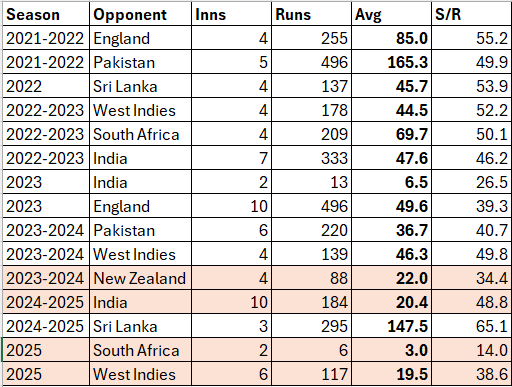
Is he finished? Is he finished against pace? Or, can legitimate excuses be found for the four series in orange?
I am writing this paragraph without knowing the results of what I am about to do next. I’ll crunch the numbers for Aussies, just in the matches that Khawaja played in those orange series, and see what comes back.
In other words, if he performed okay relative to his peers it might just be that those series - which included some tough pitches and several Tests against one Jasprit Bumrah - were just hard work for batters, and that it would be a mistake to dispense with Khawaja based on them.
Or maybe he really did just struggle.
Okay, I’m off to extract the numbers - I’ll paste them in next:
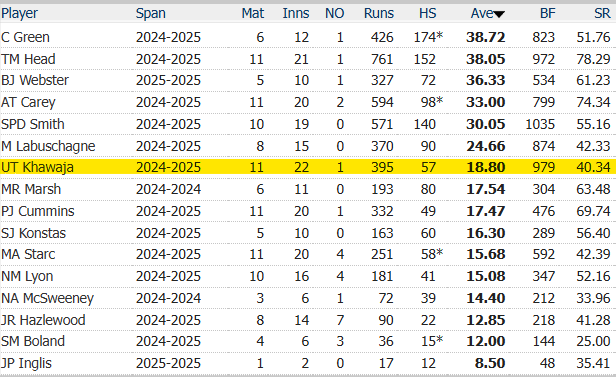
What do you think?
An average of 19 for Khawaja - not good. But don’t forget the premise of the exercise: I picked his very worst few series. Other than Bradman, every batter would look bad.
And as I had suspected, the averages are indeed low across the board.
What it does show, incidentally, is the value of Green and Webster. They, along with Head, have been the best, in tough circumstances. What rubbish is the notion that both cannot remain in the side if Green is bowling again!
In summary, not much has changed for me. If Khawaja scores plenty of runs in the Shield before the first Test, I’d pick him; if not I wouldn’t.
Ball 2
In looking at the England Ashes squad I am going to name two batters to watch - who I think might be key to England’s chances. I’m not naming Root because he is an obvious one and well known by Aussie fans. Instead, I am going with Harry Brook and Jamie Smith.
Harry Brook: England clearly think he is going to be a fixture in the side for some time - they have just named him as vice captain instead of Ollie Pope. And, just looking at his numbers alone, he shapes as England’s future batting star. He’s 26 and has played 30 Tests with a marvellous average of 56.5 - and a quite extraordinary strike rate of 87.5.
For years, Sehwag and Gilchrist had the highest career Test strike rates - in the low 80s. Well, Brook has swept passed them (with current England opener Ben Duckett not far behind him!).
The only question mark against Brook is: can he do it when conditions are tough? I don’t think he is a flat track bully - although some do - but can he excel against the best? This Ashes series might go quite a way towards answering that question.
Jamie Smith: England’s wicketkeeper has made a stunning start to his Test career. He’s 23, has played 15 Tests and averages 48.9 at the very rapid strike rate of 75.2. I watched him score a century in England’s recent home series against India - and it was jaw dropping. It was hard to imagine anyone batting better, frankly!
A bit like with Brook, if he can maintain this standard he is a star in the making.
As for his glovework - regular readers know that as long as the keeper is decent or better, I don’t think it makes much difference. Indeed, I might even pick my all-time England eleven on TikTok and put Smith in as keeper - even though it is illegal to choose anyone but Alan Knott!
If Brook and Smith leave Australia with their reputations intact or even enhanced, then England might well be leaving with the Ashes.
Ball 3
And now the same exercise with England’s bowlers. Again, I am not going to pick Archer as he is too obvious: if he performs to his 2019 standard then the Aussies will have their hands full. Instead, I’m choosing Atkinson and Carse.
Gus Atkinson: Aged 27, a right-arm fast medium bowler who is 188cm and has played 13 Tests and taken 63 wickets at an average of 22.0. In all first class cricket, he has a slightly worse - but still more than decent - average of 25.2. And if you look at his first class bowling average just from the England summer of 2023 onwards, his average is 23. He’s a handy lower order batter too.
I don’t know or care what his body language is like, whether he has the right ‘character’ for Test cricket, if he really ‘wants to win’ or any of the other madcap stuff that people seem to value. I am interested in the numbers - and on those he looks very decent indeed.
Brydon Carse: England clearly rate Carse highly. I am not so enamoured of him - but, clearly, I might well be wrong. If I am and if he is as good as England think, this might have Ashes determining significance. He’s 30, he’s 191cm and he bowls right arm fast medium. In 9 Tests he’s taken 36 wickets at 30.1. and his overall first class average is 32.9. From the 2023 English summer onwards, his first class average is 35.
Based on those figures, I am willing to bet he will be another of the many England quicks who come here and get spanked, but time will tell. In his favour is that, like Atkinson, he’s a handy batter - indeed more than handy: he averages 29.6 in first class cricket.
Ball 4
Which version of this piece do you prefer? Bear with me - please read them both and decide, before reading the explanation at the bottom!
Version 1
I told yers!
Ravi Ashwin is coming to the BBL(!) . . . albeit to the Sydney Thunder rather than the Sydney Sixers as I would have preferred.
This single move will raise the profile of the Big Bash significantly. Ashwin is a big star in India and, importantly, still near the top of his game.
He is smart, charismatic and opinionated. And he has a point to prove.
Evidently he is a bit miffed with the BCCI - his withdrawing from the national side and the IPL in quick succession certainly came as a surprise to me - and will be eager to show he can thrive without them.
Sadly, Ashwin’s time with the Thunder will be brief - he’ll join them only from their third last game. (This is because he was to have been playing in the UAE T20 (the ILT20) - however, in something of a sensation, overnight he went unsold in the auction, although might still get signed as a wildcard.)
This must irk Cricket Australia no end.
Australia has infinitely more cricket heritage than the UAE, better stadiums and a better quality of life. Once BBL wages rise, surely players will choose the BBL over it competitors - and if private investment is needed to make this happen, Cricket Australia might decide it is worth it.
Version 2
Ravichandran Ashwin is heading to the Big Bash — to the Sydney Thunder rather than the Sixers — and that single signing will lift the league’s profile. He remains a front-line spinner of rare craft, and he brings star power from India that the BBL has struggled to tap in recent years.
Ashwin isn’t just elite; he’s box-office. Smart, charismatic, opinionated — the full package. After withdrawing from the national side and the IPL in quick succession, his motivations will be scrutinised, but the competitive fire has never been in doubt. He’ll relish proving he can thrive outside the Indian system.
The catch: his stint will be short. As it stands he joins the Thunder only from their third-last game. He was expected to be in the UAE’s ILT20; in a twist he went unsold at the auction (a wildcard still possible), but the window for the BBL remains narrow.
That reality underlines a bigger story. Cricket Australia will be frustrated that a league with Australia’s heritage, venues and lifestyle still has to squint at overseas calendars and auctions to land a marquee for a handful of matches. Until BBL contracts are materially more competitive, the league will keep losing availability — if not players entirely — to rival tournaments.
The pathway is obvious. Lift wages to a level that makes the BBL a first choice rather than a consolation, and consider private investment if that’s what it takes. The audience is there, the grounds are there, and the product works when the stars show up. Ashwin’s arrival proves the draw. The next step is ensuring signings like this aren’t cameos.
Explanation
The reason for the two versions? The first is mine. The second is mine after being put through Chat GPT with the instructions, ‘Polish this piece up so it becomes good enough to be in a major cricket publication. Make whatever changes you deem fit to raise it to this standard.’
I think the results are very interesting.
In my opinion, Chat’s version is indeed more polished; it’s snappier and more professional sounding.
But it also has the hallmarks of AI-influenced writing. It’s derivative and a bit bland and it contains some giveaways:
*The use of em dashes in ‘the league will keep losing availability — if not players entirely — to rival tournaments.’ Although these ‘long dashes’ are grammatically correct, they are often an indicator of AI involvement.
*The line ‘Ashwin isn’t just elite; he’s box-office,’ is classic AI. Saying ‘Something is not just something it is something else’ is an addiction for AI. I recently read a prominent ex cricketer’s article in which he used this construction five times.
*Phrases like ‘rare craft’, ‘struggled to tap’, ‘the competitive fire has never been in doubt’ just sound AI. When an article is full of them, I get suspicious.
More and more articles are being written fully or entirely by AI. At the moment, if you know what to look for it’s easy to spot. Whether this will remain the case in future is unclear!
Ball 5
I randomly came across this article from the Sydney Morning Herald.
The opening line of the article could well have applied to any of England’s last three tours to Australia but it is actually from the third Test of 1974/75.
’England are in tatters, their hopes of an Ashes revival torn to shreds and cast aside like so much crumpled and useless Christmas wrapping paper.’
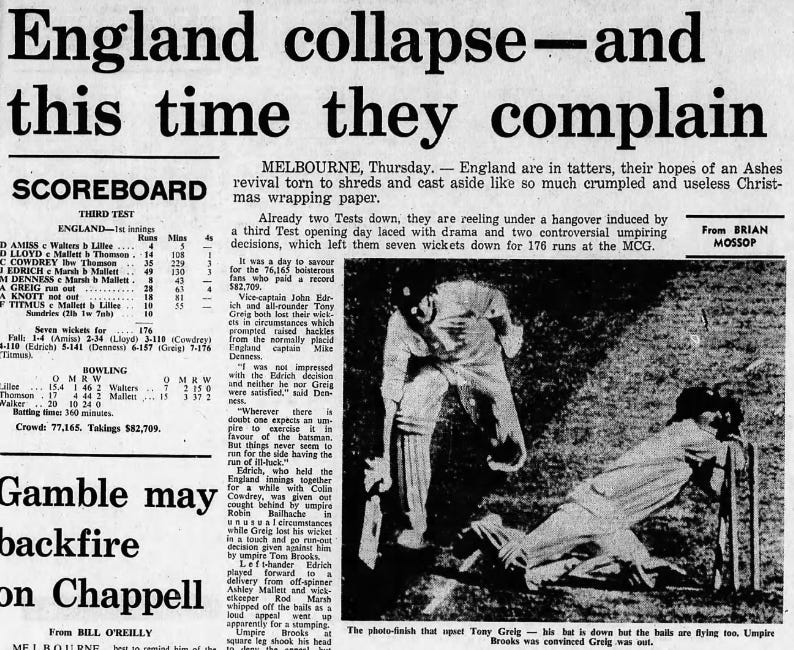
76,165 people had packed the MCG to see England - already two-nil down after two Tests, again face the fire of Lillee and Thommo.
The article goes on to highlight two controversial decisions that England were not happy about: John Edrich given out caught behind and Tony Greig given run out.
The Edrich caught behind is inconclusive from the footage, (in my opinion anyway). No ultra edge in 1974! But I suspect it was not out. See for yourself - it is at the 06:10 mark.
A still of Greig’s run out is featured in the newspaper article, the photo having been taken just a fraction too late to be useful.
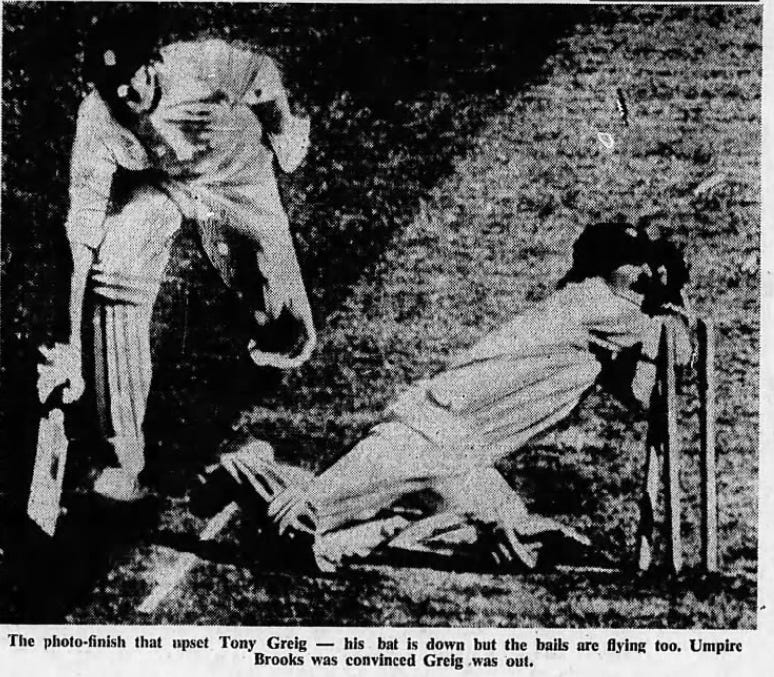
The footage is in the same clip as above, from the 08:30 mark; I have also included a zoomed in, frame-by-frame clip here.
What do you think?
Initially it looks like Greig is going to make it but his bat seems to lose speed at the key moment. I think the stump nearest to Marsh’s gloves moves before Greig’s bat crosses the line. The footage is too grainy to allow a definitive opinion but my inkling is that with modern camerawork Greig would have been shown to be out.
However, it’s really too close to call - and one that the onfield umpire should have given not out.
Poor old England - already 2-0 down, they were being blitzed by Lillee and Thommo.
And, if you ever need reminding of what a wonderfully aggressive captain Ian Chappell was - have a look at this field he set for Thommo bowling to John Edrich. Four slips, two short legs and a leg gully!
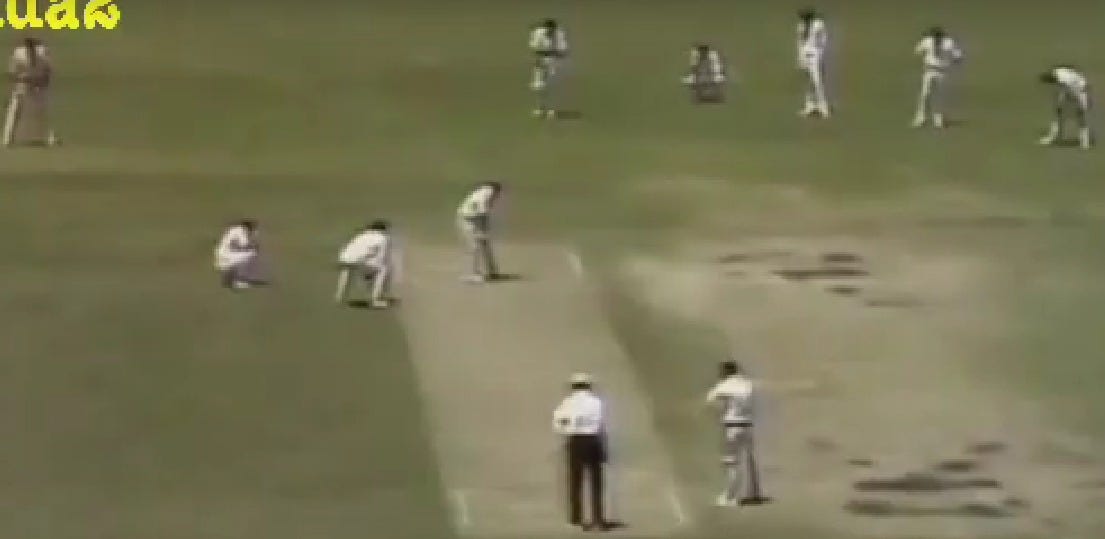
That’s Dennis Lillee, by the way, in an insanely close position - especially in pre-helmet days!
For the record - this Test finished in a very close draw, but Australia went on to win the 6-match series 4-1.
Ball 6
This upcoming summer will mark half a century since one of the most significant ever summers in Australian, and indeed world, cricket.
The series against the West Indies in 1975/76 was billed as a world title fight - but Australia ended up winning convincingly.
Stung by the loss and by the ferocity of the fast bowling, Clive Lloyd resolved to do away with spinners and pick a four-pronged pace battery going forward - it was the beginning of two decades of West Indian dominance.
But it was also significant from a television point of view. Have a look at this TV guide, from the MCG Test match:
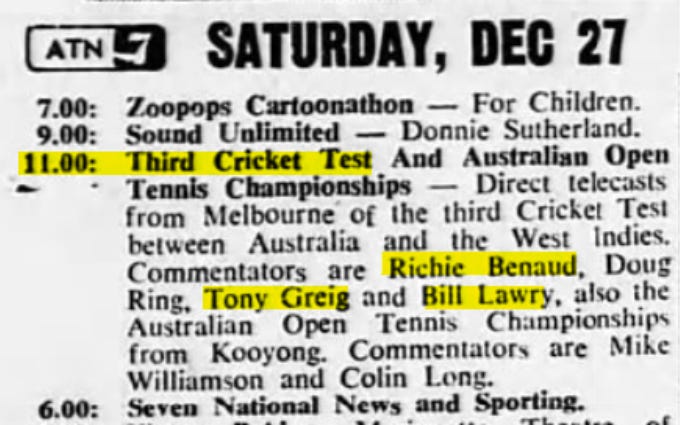
Notice anything?
It is being shown on Channel Seven and look at the commentators: they include Richie Benaud, Tony Greig and Bill Lawry.
People often think that prior to World Series Cricket, televised cricket in Australia was the sole preserve of the ABC. Well, certainly the ABC did do the bulk of it (including this summer - 1975/76 was a rare summer in which two free-to-air networks covered the cricket), but the commercial networks did get involved from time-to-time too.
I think it quite neat that 1975/76 saw three of the four mainstays of what would become the legendary Channel Nine commentary team working together for the first time (the fourth, Ian Chappell was still playing), and for a rival network.
As the huge crows rolled in to the grounds and as Channel Seven no doubt got good ratings, I wonder if one Kerry Packer was watching and thinking, ‘I’d love this on Channel Nine - but I’d want exclusive rights. And if I do get it, I’d want Richie, Bill and Tony too’?